
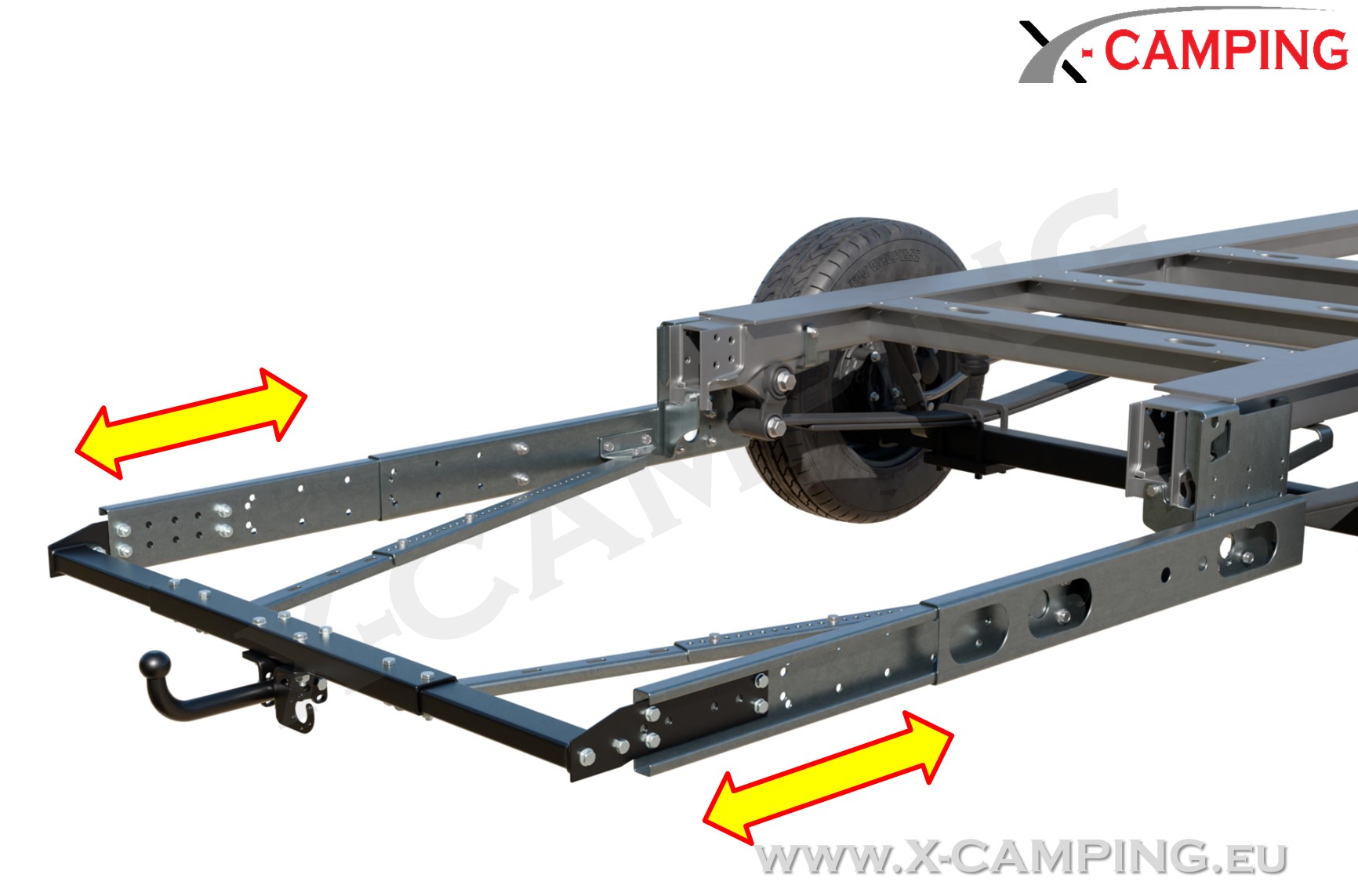
Load-bearing chassis extension for retrofitting a towbar
Whether it’s a bike rack, motorcycle carrier, rear box, or trailer – many motorhome owners want to retrofit their vehicle with a towbar or a rear carrier system. However, the standard vehicle frame often ends under the living area, providing an insufficient base for securely mounting additional loads. This is precisely where a chassis extension comes into play.
It extends the load-bearing vehicle frame to under the rear overhang, creating a stable base for mounting a towbar or other rear carrier systems. Modern, adjustable-length chassis extensions offer a decisive advantage: they can be flexibly adapted to different vehicle lengths and are suitable for numerous motorhome models and chassis.
As a specialist in towbars and chassis extensions, X-CAMPING develops solutions for almost all recreational vehicles – from compact camper vans to semi-integrated and fully integrated motorhomes, and alcove vehicles. The range includes systems for standard chassis, AL-KO chassis, and Hymer SLC, as well as the most common base vehicles like Fiat Ducato, Mercedes-Benz Sprinter, Ford Transit, Renault Master, Volkswagen Crafter, and MAN TGE.
In this guide, you will learn when a chassis extension is required, what the differences are between fixed and telescopic systems, and why adjustable-length designs are now the most flexible solution for motorhome owners, workshops, and dealers.

What is a motorhome chassis extension?
A chassis extension is a load-bearing steel structure that extends the standard vehicle frame to the rear. It serves as a stable connection between the original chassis and a towbar or other rear attachments.
Depending on the vehicle type, the chassis extension is attached directly to the original frame or to an AL-KO or Hymer SLC chassis using special adapters. High-quality systems are made of high-strength steel and are bolted, creating a durable and resilient connection.
In contrast to classic designs, modern chassis extensions often feature a telescopic construction. This allows their length to be precisely adjusted to the respective rear overhang without the need to shorten profiles or custom-make them.
Why do many motorhomes not have sufficient frame length?
Motorhomes are produced in two manufacturing steps. First, the vehicle manufacturer supplies a chassis with a cab. Then, the motorhome manufacturer builds the living area onto this chassis.
To achieve as much living space, large rear garages, and comfortable layouts as possible, the living area is often made significantly longer than the original vehicle frame. This creates what is known as the rear overhang.
While this additional space offers valuable storage, there is no load-bearing structure under the rear of the vehicle to which a towbar or rear carrier system can be securely attached.
Especially for vehicles with AL-KO low-frame or Hymer SLC chassis, a specially developed chassis extension is often required.

What is the purpose of a chassis extension?
The most important task of a chassis extension is to safely transfer all forces generated when towing a trailer or transporting loads at the rear of the vehicle into the vehicle chassis.
It forms the technical basis for numerous retrofits, including:
- Towbars
- Bike racks
- E-bike carriers
- Motorcycle and scooter carriers
- Rear boxes
- Transport platforms
A high-quality chassis extension not only ensures secure attachment but also distributes the forces evenly across the vehicle frame. This increases stability, reduces material stress, and contributes to the long-term operational safety of the entire vehicle.
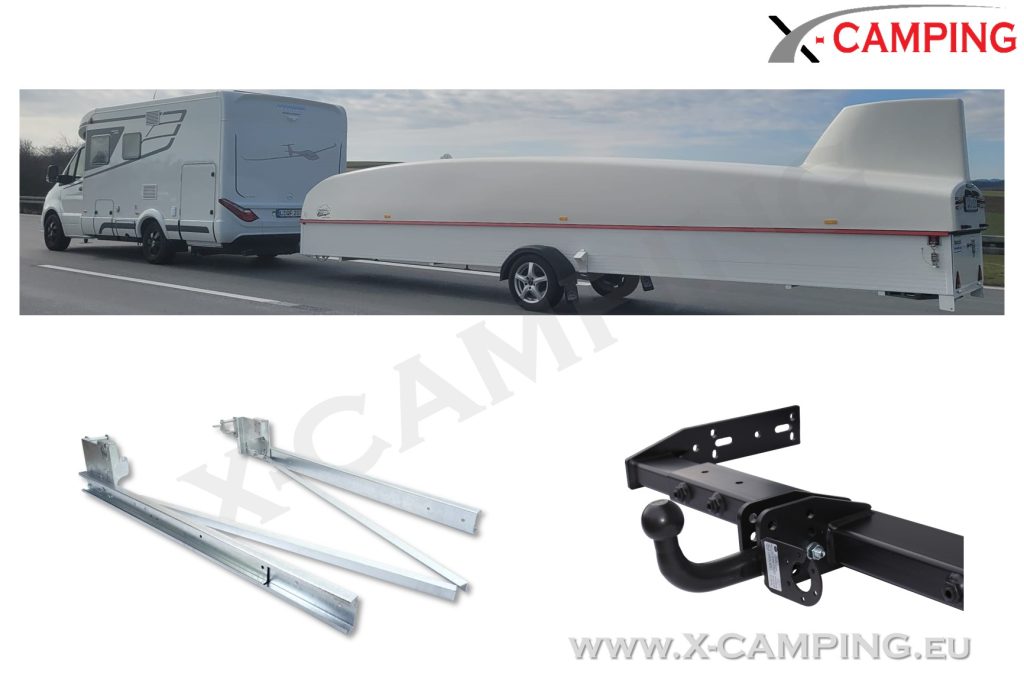
When is a chassis extension needed?
A chassis extension is always required when the standard vehicle frame does not extend far enough to the rear of the vehicle to safely accommodate additional loads.
Typical applications include:
- Retrofitting a towbar
- Mounting a bike rack or e-bike carrier
- Transporting a motorcycle or scooter
- Installing a rear box
- Retrofitting a transport platform
While vehicle-specific chassis extensions are available for some vehicles, more and more manufacturers are opting for adjustable-length systems. These can be flexibly adapted to different vehicle lengths and cover numerous motorhome models with just one design.
Which motorhomes require a chassis extension?
Whether a chassis extension is required primarily depends on the chassis used and the construction of the motorhome. While camper vans often already have a sufficiently long vehicle frame, in many semi-integrated, fully integrated, and alcove motorhomes, it ends well before the rear.
The larger the rear overhang and the rear garage, the more likely a chassis extension will be used.
Standard Chassis
Motorhomes built on classic van chassis make up the largest market share. These include:
- Fiat Ducato
- Citroën Jumper
- Peugeot Boxer
- Mercedes-Benz Sprinter
- Ford Transit
- Renault Master
- Volkswagen Crafter
- MAN TGE
- Toyota Proace Max
Since the living area often extends beyond the end of the original frame, an additional chassis extension is often required for mounting a towbar.
AL-KO Chassis
The AL-KO low-frame chassis is one of the most popular chassis in European motorhome construction. Its low weight, low center of gravity, and excellent driving characteristics make it the first choice for many premium manufacturers.
However, due to its special frame geometry, specially developed adapters and chassis extensions are used here. They enable secure mounting of towbars and rear carrier systems without compromising the stability of the chassis.
Hymer SLC Chassis
The Hymer Super Light Chassis (SLC) was specially developed for high-quality Mercedes-Benz Sprinter motorhomes. Its lightweight yet extremely torsion-resistant construction places special demands on accessory components.
Here too, specially adapted chassis extensions ensure that towbars and other rear attachments can be securely mounted. Especially for vehicles with a large rear garage, an adjustable-length design offers the advantage that it can be precisely adapted to the existing rear overhang.
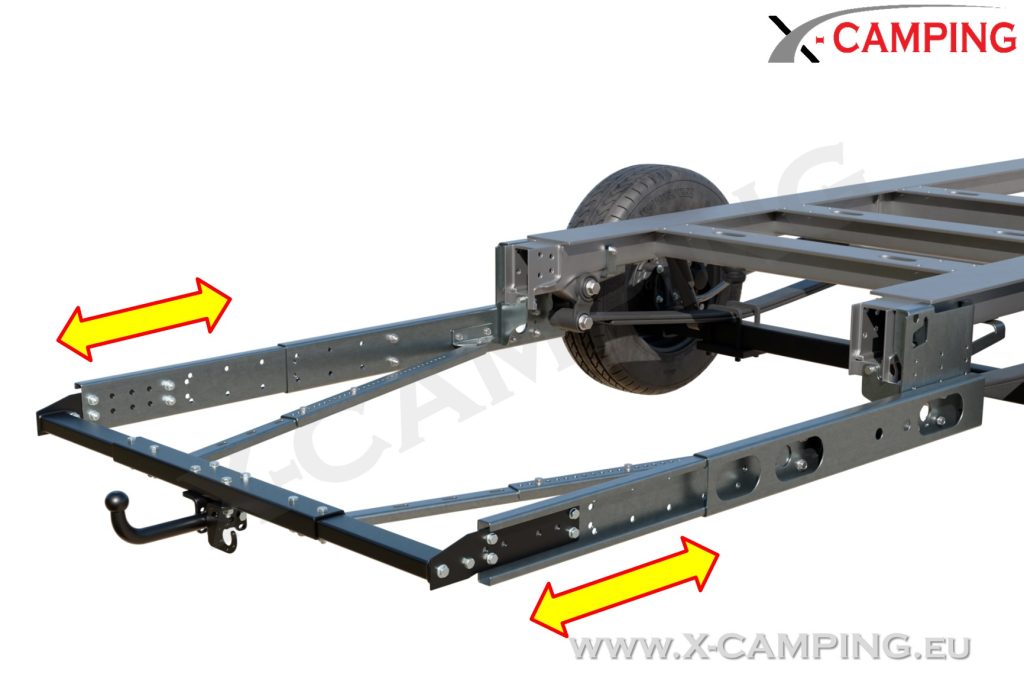
Fixed or adjustable-length chassis extension?
Anyone looking to retrofit a towbar or rear carrier to their motorhome will sooner or later face the decision between a classic fixed-length chassis extension and an adjustable-length, telescopic design.
Both systems fundamentally fulfill the same task: they extend the vehicle frame and create a stable base for mounting a towbar or rear carrier. However, the differences lie in flexibility, installation, and subsequent load capacity.
While a fixed chassis extension is manufactured precisely for a specific vehicle length, a telescopic chassis extension can be adapted to different rear overhangs. This makes it suitable for numerous motorhome models and offers decisive advantages for private customers, workshops, and dealers alike.
Disadvantages of classic chassis extensions
Conventional chassis extensions usually consist of rigid steel profiles with a fixed, defined length. Therefore, before ordering, it must be precisely determined which extension fits the respective vehicle.
Even small measurement errors can lead to the chassis extension being too short or too long. In many cases, the profiles then have to be shortened, additional holes drilled, or even custom-made parts ordered. This not only increases the installation effort but often also incurs additional costs.
For workshops and dealers, this also means considerable storage effort. To serve as many motorhome models as possible, various chassis extensions in different lengths must be stocked. This ties up capital, requires storage space, and complicates logistics.
Disadvantages of classic systems at a glance
- fixed length
- exact measurement required before ordering
- risk of incorrect orders
- often requires rework
- multiple variants must be stocked
- higher storage and transport effort
Advantages of a telescopic design
An adjustable-length chassis extension works on a much more flexible principle. It consists of two interlocking steel profiles, whose length is adjusted via precisely arranged rows of holes. Both profiles are then bolted together to form a stable unit.
However, the decisive difference is not just in the adjustability.
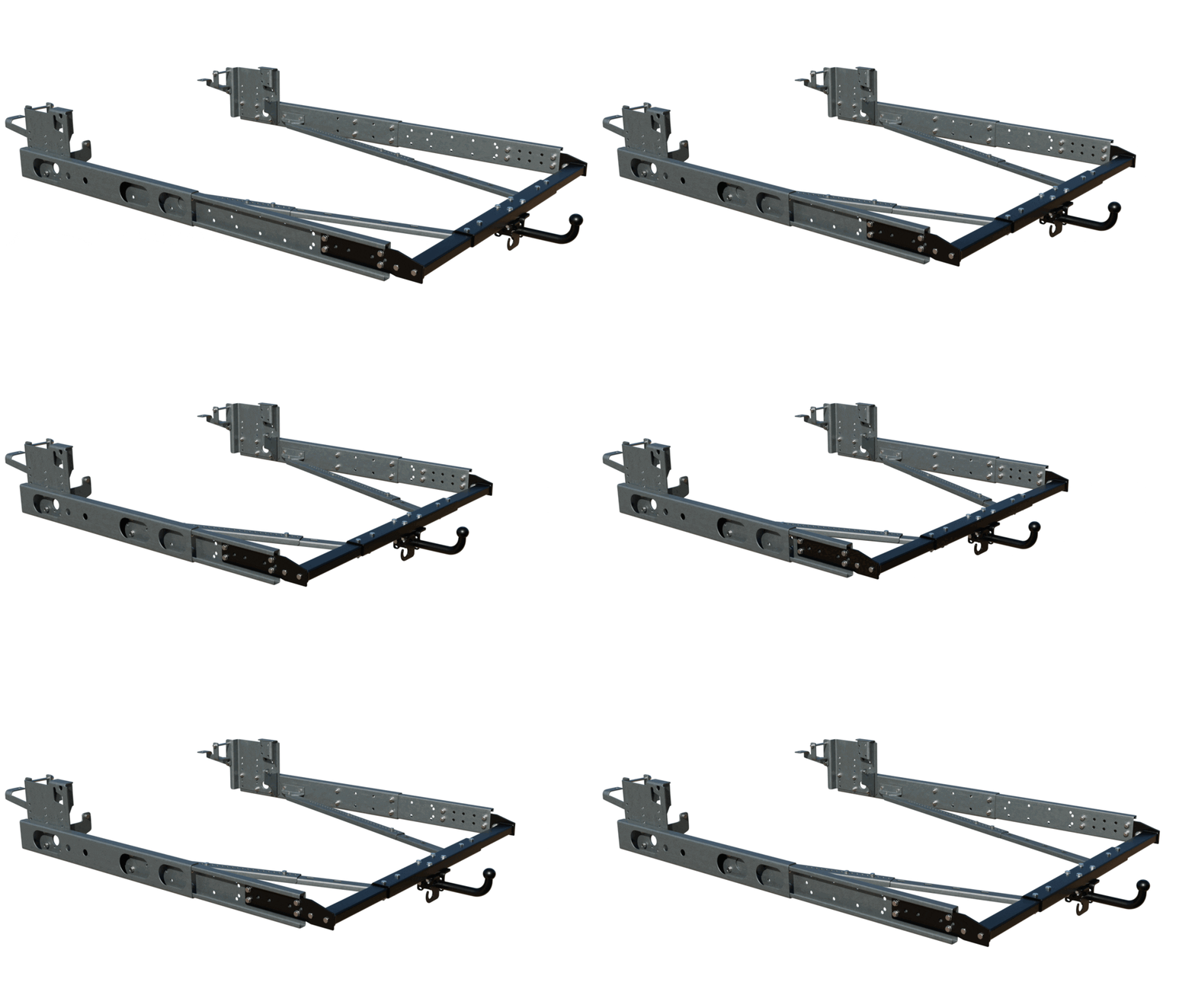
Thanks to the telescopic design, the inner and outer profiles overlap over a large area. This creates a double-walled section that significantly increases the rigidity of the entire structure.
This design offers significant advantages, especially under high loads.
While towing a trailer primarily involves longitudinal tensile forces, a bike rack or motorcycle carrier generates significantly higher bending moments. The reason for this is the long lever arm behind the vehicle.
With every centimeter of distance between the rear of the vehicle and the load, the forces acting on the chassis extension increase significantly.
Modern e-bikes, in particular, often weigh between 25 and 35 kilograms today. Two e-bikes including the carrier can quickly reach over 80 kilograms. The loads are even higher for motorcycle or scooter carriers.
This is precisely where the telescopic design plays its greatest strength.
Due to the large-area overlap of the profiles, forces are not introduced at a single point but over a much larger area into the vehicle frame. This reduces material stresses and increases the stability of the entire structure.
For this reason, telescopic chassis extensions are particularly suitable for:
- heavy bike racks
- e-bike carriers
- motorcycle carriers
- scooter carriers
- rear platforms
- transport boxes
Especially with high tongue weights, the double-walled construction offers clear advantages over simple, single-piece steel profiles.
Adjustable-length chassis extension for motorhome towbars by LEMET
Why a variable length of 850 to 1700 mm makes sense
Most motorhomes differ mainly in the length of their rear overhang. This is precisely why different chassis extensions had to be offered for almost every vehicle variant until now.
An adjustable-length chassis extension with an adjustment range of 850 to 1700 mm, on the other hand, covers the majority of motorhomes on the market.
This means:
- one chassis extension for numerous vehicle types
- adjustment directly during installation
- no special lengths required
- no rework on the profile
- significantly simpler planning
Advantages for private customers
For motorhome owners, a telescopic chassis extension primarily means one thing: security in the purchase decision.
The length does not have to be precisely determined down to the millimeter when ordering. Instead, the chassis extension is precisely adapted to the existing rear overhang during installation.
This significantly reduces the risk of incorrect orders.
In addition, private customers benefit from:
- easy installation
- optimal fit
- high stability
- flexible adjustment
- ideal for later vehicle modifications
Advantages for workshops and dealers
The economic benefit for specialist companies is even greater.
Instead of stocking ten or fifteen different chassis extensions in various lengths, a universal system is often sufficient.
This results in numerous advantages:
- lower inventory
- less tied-up capital
- better delivery capability
- simpler warehousing
- lower shipping effort
- more favorable transport costs
- faster order processing
With just a few products in stock, a wide variety of motorhome models can be served. This not only reduces storage costs but also increases availability for customers.
How the telescopic chassis extension works
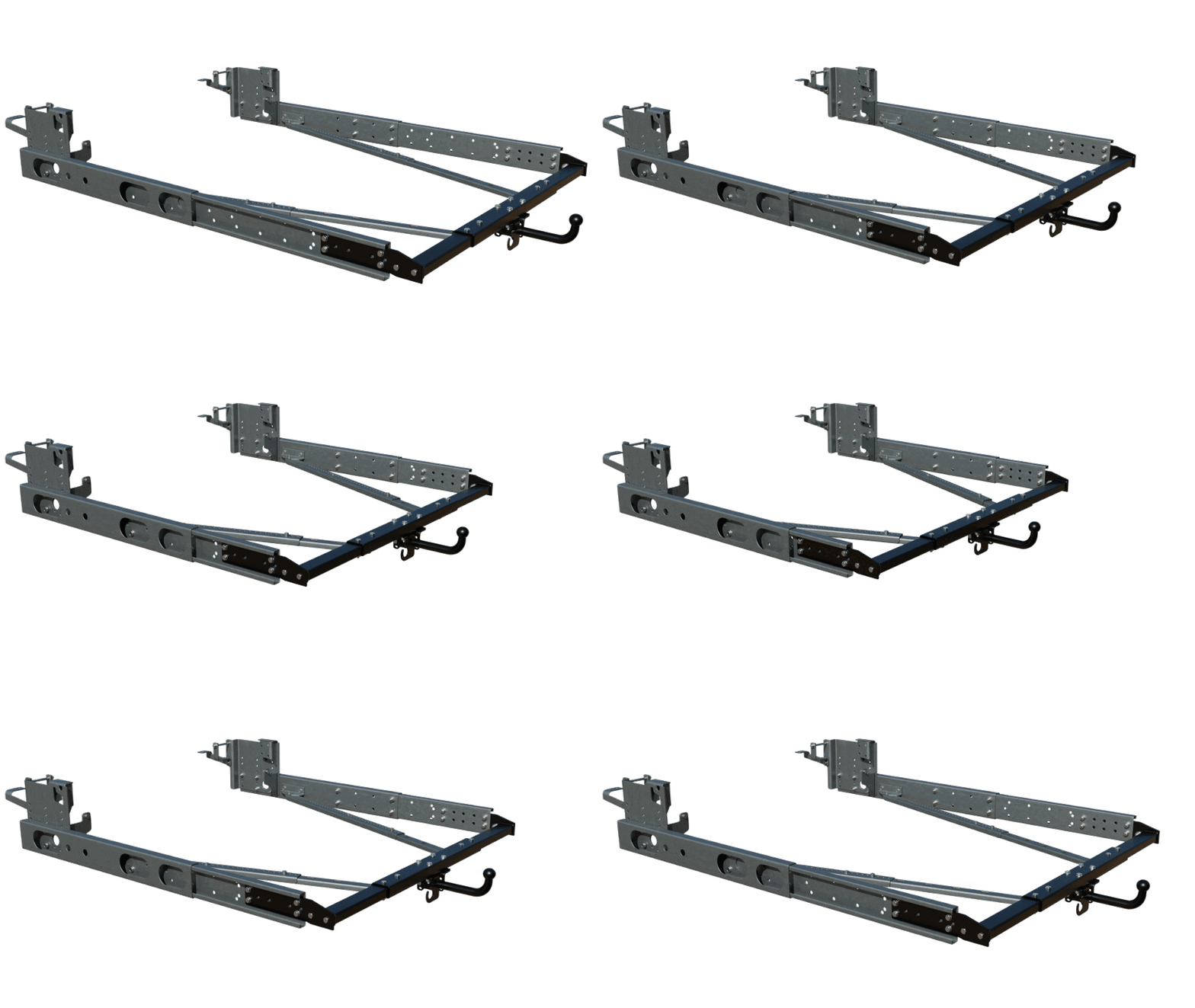
The animation shows the functional principle of the adjustable-length chassis extension. The inner profile is pushed into the reinforced outer profile and gradually adjusted to the required length between 850 and 1700 mm. Both profiles are then bolted together using the existing holes. The result is a precisely fitting, highly load-bearing, and torsion-resistant chassis extension that can be flexibly adapted to a wide variety of motorhome chassis.
Fixed or adjustable-length chassis extension? – The direct comparison
Feature | Fixed Chassis Extension | Adjustable-Length Chassis Extension |
Adaptation to different vehicle lengths | ✗ Only one fixed length | ✓ 850–1700 mm adjustable |
Installation | Often requires rework | Directly adaptable |
Risk of incorrect orders | High | Very low |
Warehousing | Many variants necessary | One system for numerous vehicles |
Transport | Long profiles, higher costs | Compact packaging, more cost-effective logistics |
Stability with heavy rear carriers | Standard | Double-walled construction with high bending stiffness |
Suitable for e-bikes and motorcycle carriers | Limited, depending on design | Especially suitable due to better load distribution |
Cost-effectiveness | Higher storage and logistics costs | Ideal for private customers, workshops, and dealers |
Conclusion
Choosing the right chassis extension is an important prerequisite for the safe retrofitting of a towbar or rear carrier on a motorhome. While classic chassis extensions are often only suitable for a specific vehicle length, adjustable-length, telescopic systems offer significantly more flexibility and simplify planning, warehousing, and installation.
Thanks to the large adjustment range of 850 to 1700 mm, a wide variety of motorhome models can be equipped with just one system. The telescopic design allows for precise adaptation to the rear overhang and simultaneously ensures high stability. Especially with heavy rear loads such as e-bike, motorcycle, or scooter carriers, the overlapping double-profile construction impresses with optimal force distribution and high torsional rigidity.
Not only motorhome owners benefit from this flexibility. Workshops, vehicle manufacturers, and specialist dealers also save storage space, reduce capital commitment, and can serve a variety of different vehicle types with just a few products.
Whether Fiat Ducato, Mercedes-Benz Sprinter, Ford Transit, Renault Master, Volkswagen Crafter, MAN TGE, AL-KO chassis, or Hymer SLC – a modern adjustable-length chassis extension provides the basis for a safe, durable, and professional retrofit.
At X-CAMPING, you will find not only suitable chassis extensions but also vehicle-specific adapters, cross members, tension struts, height-adjustable towbars, and other accessories for almost all common motorhome chassis. This way, you get all components from a single source and can optimally prepare your vehicle for your individual requirements.
Adjustable-length chassis extension for motorhome towbars by LEMET
Find the right chassis extension for your motorhome
Do you want to retrofit a towbar or need a chassis extension for your motorhome? Our experts will be happy to advise you on selecting the right solution.
In the X-CAMPING Online Shop you will find:
- adjustable-length chassis extensions
- frame adapters for standard, AL-KO, and Hymer SLC chassis
- height-adjustable towbars
- cross members and tension struts
- accessories for bike and motorcycle carriers
Not sure which chassis extension fits your motorhome? Contact us – we are happy to help.


